Most capital construction budget overruns stem from issues seeded early in the project life cycle—from ROM estimating to scope changes, execution inefficiencies, and close-out delays. By identifying where risks commonly emerge, project teams can take practical steps to strengthen cost confidence from planning through turnover.
Why Construction Budget Overruns Happen More Often Than Expected
As many as nine out of ten capital projects experience budget overruns, with the average overrun being between 25-30% of the project’s budgeted costs.
There are several reasons why project overruns exist, but if we look at the life cycle of a project, we can identify areas where we’re more likely to run over budget. The following image is a simplified representation of a project’s journey from inception to operations:
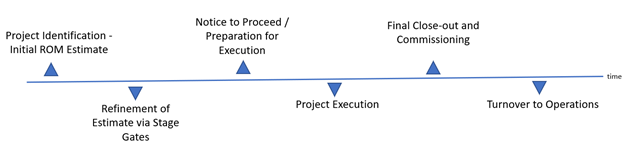
Strengthen ROM Estimates for Better Early-Stage Budget Accuracy
During the project identification stage, rough order of magnitude (ROM) estimates are typically prepared to create a budget for the project. This budget may be + / – 50% of the project’s actual costs but is an important step to get decision makers aligned on the cost of the project relative to the value the project brings to the organization.
Factors That Influence ROM Estimate Accuracy
What are some ways in which organizations can tighten up this initial ROM estimate? Many organizations rely on benchmarks, which are most valuable when a normalized history of like work, geography, skill level of local labor force, commodity pricing and other issues (regulatory, statutory, etc.) can be leveraged.
If an organization’s history does not align with these factors, then some reliance upon industry data for typical construction tasks (“norms”) can be expected. But will those norms encompass the actual work conditions expected in the field, or should they be factored to more accurately reflect the project being considered?
Key conditions that can impact ROM accuracy include:
- Congested Areas
- Incomplete Design
- Political Risks
- Extreme Weather
These factors can all negatively affect the project’s execution performance and should be considered as early as possible in the project’s journey through the various phases of planning.
Manage Design Changes and Scope Evolution Throughout Planning
As the project’s scope becomes more refined, changes to the design and engineering occur frequently. Estimating teams often struggle to keep up with iterations in the project’s design, as engineers update their respective disciplines. Controlling scope changes can be difficult, especially if the level of granularity between the estimate and the detailed design differs. In many cases, individual line items extracted from engineering tools are summarized into a cost estimate and new changes to those detailed line items can present an issue of understanding how those detailed changes affect the estimate’s summarization.
As project teams prepare for execution, it’s imperative that the actual contracts being created reflect the assumptions that went into the cost estimate. In some cases, a contingency fund can be included as a part of the estimate, to be able to offset market fluctuations such as supply chain issues and inflationary pressures.
Common Challenges When Scope Changes Occur
How are changes to scope handled as the project moves into the execution phase? Ideally, the project’s scope will have been solidified and we shouldn’t expect major changes, but in some cases these can be inevitable. Should these changes exhaust a contingency fund at this point, or is it better to re-budget the entire project? Both can and do happen on capital projects, and having a disciplined approach towards drawing down contingency can help with this issue.
Executing on Point and On Budget During Construction
During the execution phase of a project, many opportunities exist to experience overruns of both cost and schedule, which are inextricably linked. The reasons for this can be numerous: how was the level of detail in the estimate communicated to the project team? In some cases, these details are summarized to the point where project teams aren’t able to leverage the granularity with which the estimate was created. In other cases, project teams have their own ideas of how the project will be executed, which may run counter to some of the assumptions made during the estimating process.
As execution progresses, short-interval planning can help project teams to ensure the pieces of the execution puzzle, such as construction work packages and installation work packages, are put together efficiently. Daily planning can ensure that the best use of onsite resources is achieved, helping to mitigate costly delays and overruns.
Execution Issues That Commonly Drive Cost Overruns
In many cases, “side” spreadsheets maintained separately by project team members are built to capture changes, productivity levels and other issues. However, having data in too many places can take too long to tie together, providing limited visibility to the broader team. As a result, it may be difficult to identify trends prior to cost and schedule damage taking place.
Common execution-phase challenges include:
- Data spread across multiple spreadsheets
- Limited early-warning signals for productivity changes
- Time-consuming reconciliation of disparate information sources
- Fluctuating forecasts that erode confidence
By the time these side sheets are compiled and reported upon, the net result is a widely fluctuating forecast of final costs, which causes project team members and management to lose confidence in these projections.
Close Out with Confidence and Reduce End-of-Project Risk
Project close-out and commissioning, if treated as a discrete event, can cause schedule slippage, which negatively impacts the cost performance of the project. By waiting too long to create and gather the necessary documentation, project teams miss an opportunity to create a seamless handover. Successful project teams tend to act purposefully, creating and managing quality documentation and processes as they execute the project, so the ultimate close-out of the project is a byproduct of this careful planning process.
Throughout a project’s entire life cycle, another issue affecting cost performance is known as “optimism bias.” This is the tendency to disregard real-world factors, which can ultimately result in project cost and schedule overruns. Identifying these risks, and having a mitigation strategy for each, can help to protect budgets if, in fact, these issues do arise.
As we’ve seen, there is really no single trick to finding ways to keep a capital project running on time and on budget. Instead, there are several opportunities to protect budgets and schedules at the various stages within a project’s life cycle.
InEight provides project cost management software that helps teams plan with confidence across the entire construction life cycle. By improving estimate quality, connecting design and field data, and supporting more accurate forecasting, InEight helps project teams identify the early warning signs of budget overruns before they escalate.
Updated On: November 5, 2025